Pages

Saturday, May 22, 2010

Ruritan Fish Fry


If you are in Blacksburg on the second Saturday of the month from May through October you can enjoy community fellowship and a fish fry at the Mt Tabor Ruritan Club's monthly event behind Slusshers Chapel in MT Tabor.  Dinner is served from 5 until 7 P. M.

Tuesday, May 18, 2010

His craft is Instrumental


  Clinton Smith is a multi-talented craftsman. When he got to most people's retirement age he just sat down; not to retire but to craft stringed instruments.  And that has been a major focus for him for the past 11 years.


In just over a decade he has made 111 fiddles, 20 mandolins,  and eight banjos. He hasn't just assembled the instruments from kits; sometime he has started with the tree. He does buy strings but even the metal frame of the banjos are crafted in Clinton's shop.  I asked where the metal frame came from, expecting he would tell me the name of a supplier.  His answer; "from an old car transmission."  He not only is a wood worker but a metal craftsman
as well!


Clinton carefully selects the wood for the sides of the instruments and crafts them on a historic band saw that his father gave him.


(The band saw came from the shop of a Mr. Long
for which the community of Long Shop (in Montgomery County, VA. was named.  The saw has the date of February 27, 1900 welded on it.)


Clinton researched the process of instrument making and settled on a pamphlet  that he refers to frequently. He made a template that is used for all of his full-size fiddles. The template actually works for the fiddles without "ears" which he calls the "guitfiddle."


A metal template is added to make the "ears" which are on most fiddles and violins.
In his research Clinton found that Stradivarius actually made guitfiddles as well as conventional violins. Guitar fiddles are describe as instruments played in medieval times


Clinton proudly shares that Jeff Michael of the Big Country Bluegrass Band plays one of his guitfiddles.  And when I sought more information about Jeff Michael, I learned he had recorded under the Hay Holler Records label from Blacksburg, VA.


According to Clinton the "Ears" on a conventional fiddle make a convenient place to make wood joints in the sides. Since the guitfiddle doesn't have those breaks, a long clear piece of wood is needed to surround the instrument.


 The back of each instrument  is a work of art.


The finished
instruments are as colorful as a bouquet of flowers, especially when displayed on one of his wife Ann's hand-made quilts.


In the picture you may be able to recognize a left-hand fiddle.  Clinton couldn't find a chin piece for the lefty so he made one and from then on he has made all the chin pieces.


Clinton says he doesn't play but likes to get his instruments into the hands of those who do. That seems to be working to; the banjo he showed me was the last one and it was waiting for its owner to pick it up; I didn't see a mandolin, and about 60 of his fiddles are making music.

Monday, May 17, 2010

About Grist Mill Wheels

I wrote an earlier blog about McDonalds Mill. Ensuing discussions focused on the actual grinding stone wheels because I wondered where and how they were cut. My sources of information were my Dad, Bill Absher, Clinton Smith, and Buford Long. Each had a reason to be somewhat knowledgeable on the subject; Dad because he grew up next to the mill and worked with a lot of craftsmen, Clinton because he is a long term resident of Brush Mountain, and Buford because his Dad and cousin had a hand in mill wheel production.

As I understand it, there are only two seams of stone that make top quality grist wheels; one runs along the ridge of Brush Mountain and the other might be in Africa.  Brush Mountain Mill wheels are supposedly the best in the U.S. and have been sent all over the country and may have been exported.

Buford's father, Gilbert Long, helped remove the overburden with a team of horses to allow the stones to be quarried. The stone is like a sand stone of sharp and hard quartz pebbles.  There were several families that knew the trade of hammering out mill wheels; Shealor, Surface, Saville, and Hurt were names I heard. Dad worked with the Surface brothers; one was Fred ( I had a class mate that may have been his son, Freddie , that was killed in a car accident soon after we graduated).

Billie Hurt is Buford"s cousin and as of last week was still alive in a rest home near Rocky Mount. Supposedly he is the last remaining gist stone cutter.

I had a class mate. Roger Saville.  I need to remember to ask him about Doug Saville who was supposed to have been one of the better known craftsmen.

Many used up or flawed grist wheels can be seen in the Brush Mountain area like the one Clinton Smith embeded in his stone wall to greet visitors to his home.

I asked Dad where the quarries were. His response: "I did know but it wasn't important to me at the time." That's one reason I'm writing this blog; to record information that didn't seem important enough when it was happening but helps us understand our history. Help by adding to this blog.

Monday, May 10, 2010

Blacksburg's, Beautiful, Bountiful, Blooms

A drive around Blacksburg can be a colorful cruise.


Brilliant Colors!


Great variety!


A red rhododendron.


And that's just a sample of the foliage along Harding Road!

Sunday, May 9, 2010

Blacksburg Farmers Market


Interested in locally grown produce? 

You don’t have to wait until beans and ”taters” are in. You can find, salad greens, home canned produce, and baked goods as soon as  it opens at the Blacksburg Farmers’ Market.  Also available are grass-fed beef (have a healthy lunch at this booth), plants, flowers, as well as woodcrafts, candles, etc.  You might even find yummy fried pies, made right there on the spot! 


The Market is located at the corner of Roanoke and Draper Streets, just one block off Main Street in downtown Blacksburg. There you’ll find a new covered pavilion that  is open on Wed. 2-6 and Sat. 9-2 from April through October.

Saturday, May 8, 2010

Clinton Smith's hidden talent.

Clinton Smith's talent is hidden only from the standpoint that you've got to know where you are going to find him. Do you know how to get to Sunny Side in Montgomery County, VA? If you do that is a good starting point.  Or do you know about Glade,  Longshop,  Nutter's Store? If you don't know about those reference points you'd better start with Prices Fork or Blacksburg, VA.

From wherever you start, to find Clinton and Ann you must drive up the side of Brush Mountain, through well managed timber that looks like a National Forest into the Smith clearing. From that point Clinton's talent is no longer hidden. The Smith house was built by Clinton out of logs he cut and sawed, rocks he gathered and "masoned" into walls. The house is a striking display of this man's many talents. I came to see the musical instruments he has made; I found so much more!

I intend to write more at another time, but for now I want to record  some things I remember. Clinton is 77 years old. He started making  instruments about 11 years ago after his declining health forced him  to look for a job he could do while setting down. He has made 8 banjos, 20 mandolins, and 111 fiddles( including a few "guitfiddles").

I want to write about Clinton's work but I also want to write about the man. I was awed by the man of many experiences and talents that has seen so much of life and has the excitement of a young man starting out on a new adventure. I think every day has been an adventure for Clinton.

He was the second born of ten children to Grayton and Ruby Hamilton Smith.  He had three brothers and six sisters. He worked at many jobs to make a living. He built houses, tried being a brick mason, operated a saw mill, made wood burning stoves and more.

I'm anxious  to write more about Clinton and his work in the future.  Clinton Smith is burned in my memory as one of the most unforgettable personalities I've ever met. I want to do justice as I introduce him to you.

Friday, May 7, 2010

Mountains dress for Mother's Day

I drove through the Appalachians the week before Mother's Day and I thought, "they are all dressed up for Mother's Day!" The variegated verde provided an eye easing backdrop for the ornamentation of the showy white locust blooms, and the occasional Palownia tree. I've learned to play a game with myself, trying to spot the Palownia blooms since a forester, Don Graves,  introduced me to the exotic tree. Palownia's light purple color stands out with almost inverted cones of color.
I understand the plant originated in China and is appreciated for its fast growing production of wood that has a high strength to weight ratio. It is an honored tree in the far East and its wood is valued for making musical instruments. Don told me that a timber buyer would visit a particular tree several times before purchasing it. The buyer would know how the trunk would be sectioned into usable wood before it was harvested.  It has been a tree of choice for mine reclamation purposes. With all the positive things, some say the tree is ugly after it finishes blooming. Leaves can be huge and some consider it an invasive specie.

The fringe of the forest are adorned as well with azaleas, rhododendron and redbuds. Redbud trees have mostly transitioned from its brilliant pinkish-purple to heart shaped leaves-appropriate for the season, no!

May we all honor our mothers or mother's memories with such a display of affection!

Sunday, May 2, 2010

Back Road Trip and Back


There are many back roads but in Montgomery County there is the Back Road. We have a map in the Cozy Cottage that describes the county in the late 1700s and it shows the Back Road running along the base of Brush Mountain in a north west direction and somewhat parallel to a trail identified as the Indian Road.
State Route 785 roughly follows the Indian Road along the North Fork of the Roanoke River from Luster's Gate to Catawba.  Our Cozy Cottage is on Harding Road which is also  SR785 just out of Blacksburg

A circle trip covering both of these historic trails can make a  pleasant casual outing or fill an afternoon with photo opportunities of country scenes. It is a short trip towards town to the intersection of Harding and Patrick Henry Drive. Patrick Henry connects to North Main Street. By traveling north on N. Main you will find Mt. Tabor Road which connects with the Back Road.  While it is not clear where one road starts and the other begins , once you navigate the first big curve crossing Mill Creek you know you are on the Back Road.

A short circle can be selected by turning down Dry Run. But continuing down the road increases the photo opportunities.


Even the rare straight stretches can fill your lenses with colorful contrast...


... a brown bromsedge covered hill contrasts with the green
meadow...


... or if horses or homes attract your fancy, there will be something to add to your photographic album.


We started our circle back by turning down Gallion Ridge.   A surprise awaits on Gallion Ridge; a French B&B.

This gravel connector leads you to a panoramic view of the upper Roanoke Valley and directs you onto 785 at a point to get a good view of the Yost's log house and McDonald's Mill.

The road passes many marked and unmarked
 historic landmarks as it meanders towards
Luster's Gate. The old Grubb's House must have a
 lot of stories. It appears old enough to have
been there when the road was the Indian Road.


The log store was operated by Walter Bennet and Bax Johnson was often there according to my dad. This was a place to buy supplies or visit with Bax. You get the impression farmers didn't need many supplies!


You know you are making a circle when you see another non functioning mill that was fed by Mill Creek, the same one crossed near the start of the Back Road. The old map identifies it as Bennet's Mill.


This attractive home was formerly a school until consolidation. You can see it was well built as you observe the straight lines of the old school.


You can complete the circle by continuing on by the old cheese plant, up the mountain, around Ryan's Curve( or Craig's Bend) , passing the Bug Shop to Wrights Way and the Cozy Cottage.

There are many places of interest neither photographed nor described in this blog. That means we will just have to make the loop again!

Monday, April 26, 2010

McDonald's Mill

McDonald's Mill is located on VA State Route 785 about 10 miles from Blacksburg towards Catawba.

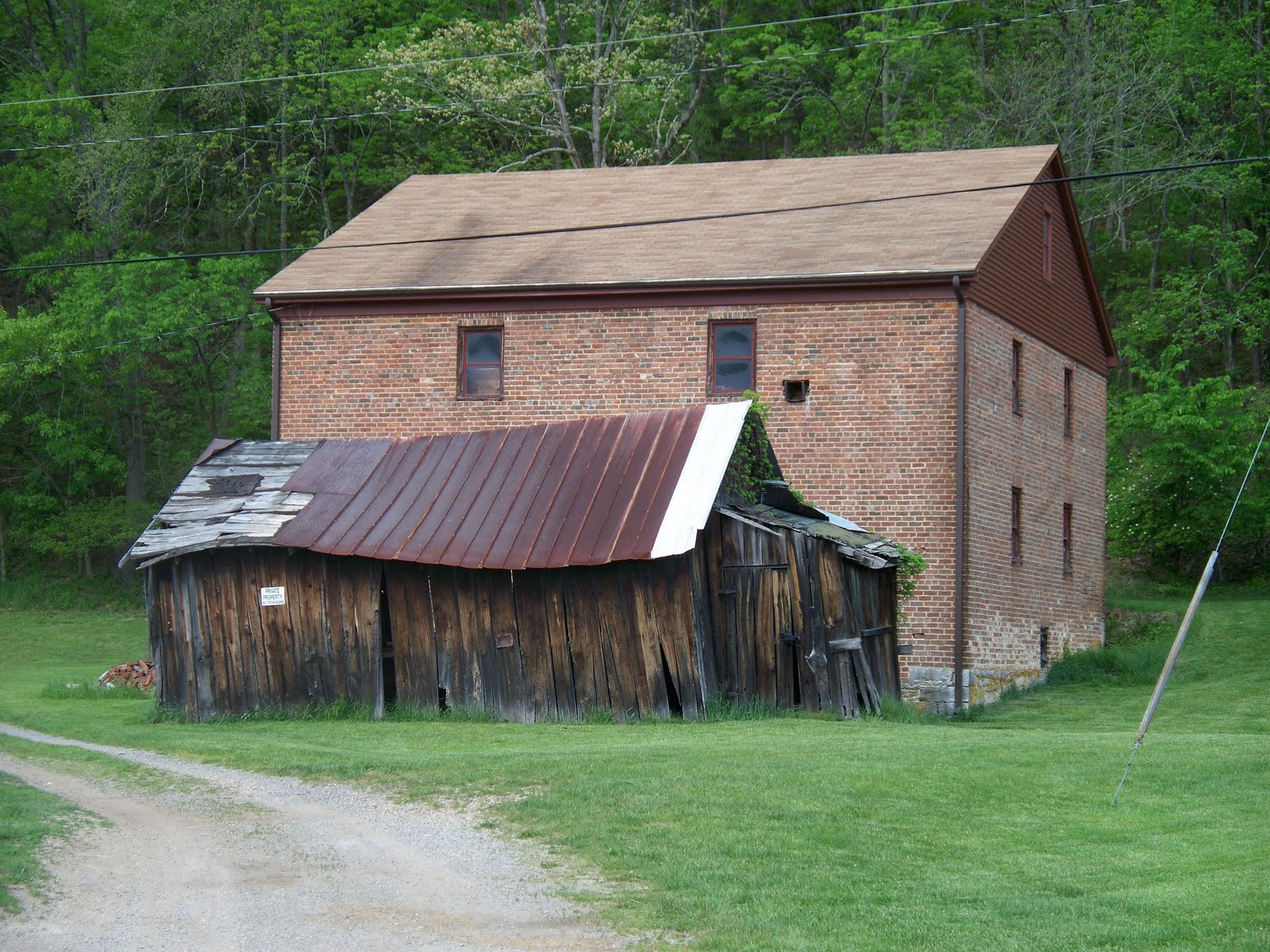
 The current McDonald's Mill was built in 1861 and was featured in a Roanoke Times article about land trust.  It pleases me that the current owners, Ned and Janet Yost, want to preserve the mill and the land around it so that others can get a glimpse of life on the North Fork of the Roanoke River as it was when the region was first occupied by immigrants from the British Isles.  The origin of the creek  that eventually becomes the Roanoke River is just a mile or two from Dad's home place. The fledgling stream gathered water quickly  from springs and hollows and in a short distance, was big enough to make a mill pond inside the current Montgomery County line. The stream was dammed and a race was constructed of lumber sawed for nearby forest to carry the water to the top of the mill wheel several hundred yards downstream. According to Yost, the mill was established in the 1790s and was operated by five generations of McDonalds. Two buildings preceeded the current structure that Yost purchased in 1952.

An idle grinding wheel serves as a reminder of the past and a durable picnic table near the meandering stream.

Dad has vivid memories of the mill and its importance to the neighborhood that took on its name. He had worked with his dad, brothers, and neighbors to wrestle out a living on the steep hills and narrow bottoms of the upper North Fork. While still a boy, he remembers playing in the mill. He remembers when the wooden races became so broken that a steam engine was brought in to replace the water power. But in the beginning, the creek was the reason the mill was where it was and the mill was the reason that a community grew up around it. 


                                                    The unharnessed North Fork of the
                                                    Roanoke River now by-passes the
                                                    Historic Mill.

Monday, April 19, 2010

A Visit to the Bug Shop

A newcomer to Blacksburg or a visitor with car trouble may not think about driving two miles out of  Blacksburg on Harding Road to get help. But local folks have been making the trip for years to The Bug Shop or Wright's Garage as it was originally known. While the new name indicates a speciality it implies a narrow customer base which is inaccurate. Jewel Albert and his knowledgeable mechanics work on cars and trucks of all makes.

One of my fondest memories of my boyhood neighbors was Arthur Wright, the original proprietor of Wright's Garage.  Mr. Wright had been badly disfigured by a fire when he was a small child to the point that you couldn't see his smile. But only a short conversation would reveal to you a happy man with a smile in his heart. He and his boys provided reliable service at a reasonable price. You generally got more than a repair when you visited the shop. There always seemed to be lots of laughter and in-fun-picking that didn't necessarily stay in the family. The Wrights would greet you with a smile and try to let you leave with a grin or a laugh.

Jewel and his crew seem to carry on the tradition of the building in which they work. They know about customer service and practice it with a smile.

My parents live about 1/2 mile up the road from the Bug Shop. Several years back, Dad fell in the garden and couldn't get up by himself. Mother couldn't help him so what did she do? She called the Bug Shop! They didn't need a wrecker but Jeff was there in a flash to get Dad up and running ( walking) again. Everybody needs that kind of neighbors.

Monday, April 12, 2010

Va Tech remembers


April 16 Memorial Bench dedication scheduled for April 15

BLACKSBURG, Va., April 12, 2010 -- Virginia Tech will honor the community of survivors of April 16, 2007.
A ceremony will be held April 15, 2010, at 4 p.m. dedicating two sitting benches — one located on each side of the April 16 Memorial in front of Burruss Hall. Charles W. Steger, president of Virginia Tech; Mark McNamee, senior vice president and provost; and representatives of the community of survivors will offer remarks and officially dedicate the benches.
The ceremony is open to the public and will be immediately followed by a reception on the Drillfield with musical selections played by the University Student Brass Quartet.
The benches, which will serve as a location for personal reflection and remembrance, honor the survivors of April 16, 2007, and the resilience of the Virginia Tech community.
In the event of inclement weather, the dedication will take place in the Commonwealth Ballroom, Squires Student Center.
About the memorial benches
The bench seats are 52 inches wide, 18 inches tall, and 8 inches thick. They are made out of a special concrete mixture that simulates Virginia Tech's native limestone, Hokie Stone, and each bench weighs approximately 900 lbs. The benches are inscribed, "In Honor of the Survivors – April 16, 2007."
Due to planned events and a large number of anticipated attendees, on-campus traffic and parking will be affected beginning April 14. Details about traffic, parking, and transit information can be found online or by calling (540) 231-3200.
Contact Meghan Williams at iwill07@vt.edu or (540) 231-4754.

Saturday, March 27, 2010

Welcome

Welcome to Harding Place Cozy Cottage
The Cozy Cottage is located just 1/4 mile from the city limits of Blacksburg, Virginia, the home of Virginia Tech.

The Cottage is a renovated farm house planned to provide a comfortable environment for family, friends, and guests. The Cozy Cottage is available for vacation rental with variable rates depending on the season or activities of the dates.

Winter rates are set to make it attractive for parents to visit their VT student, or for Blacksburg natives to come home for a visit. The West Virginia Winterplace ski resort is about a 1-1/2 hour drive which is almost to Tamarack, W. VA.'s marketplace of premier crafts.

There is also a lot to do in the Summer around Blacksburg:mountain photography, hiking mountain trails, visiting museums, eating at one-of-a-kind restaurants, or rocking and reading on the front porch of the Cozy Cottage. Deer can be seen about every morning and the mountain climate make Blacksburg mornings invigorating.

Peak-season weekends are VT graduation and Hokie home football. While rates are higher at these peak times, staying at the Harding Place Cottage is comparatively affordable, and the proximity to Blacksburg and VA Tech is a real bonus.

Learn more by checking out  http://www.craigslist.com,  Virginia, New River Valley, Vacation Rentals or  http://www.cozycottagevirginia.weebly.com


Sunday, March 21, 2010

Coming Home


Coming Home

Reminiscing September 15, 2006

Today, I drove Dad’s 1979 GMC truck to the refuse dump/recycling center. I drove down Ryan’s curve, up through Happy Hollow, out Mt. Tabor road, down Bishop Lane, up Hwy 460 and then into Coal Bank Hollow. The trip was about 3 miles long, and because I didn’t want to distribute my trash over the scenic countryside I never got in high gear. The return trip was even more interesting because I turned wrongly on Bishop road going the other way from where I had traveled it before. I give you these travel details to illustrate that you don’t go straight to anywhere in Montgomery County, Virginia. In my short trip I could see sets of mountain ranges in every direction with a different view at each turn. This is the heart of the Appalachian Mountain Range. Just a few miles from Coal Bank Hollow, one can get on the famous Appalachian Trail that meanders along ridge tops of these Eastern Mountains from Maine to Georgia.

I was taken with the beauty of this pre-fall. Technically it is summer but in the Virginia Highlands there needs to be more seasons to describe the climate adequately. It was sweltering hot just a week or so ago and it will probably be that way again before serious leaf fall. But for now it we have the green of spring, the yellow (Golden Rod) of late summer and the coolness of fall, not cold but the kind of cool that makes you enjoy physical activity outside. I had the windows down and at my slow pace the breeze was refreshing. It almost made the trip to the dump something to write home about.

I turned 66 last month. I left Blacksburg when I was 23. Why? I had graduated from Virginia Tech, for one thing and I wanted to further my education at a Western university. But still I ask, why? I thought, “I’ll bet Daniel Boone had some of the same interest that I experienced when I was younger.” “What’s beyond that mountain? What adventures lie ahead? If I leave can I find my way back? Those were real questions for me and I have a career full of stories. But more importantly, I have a large family that still recognizes that they have roots in these Virginia Mountains.

What is it like to return to the mountains? It is not a complete return but the times at home have been more frequent and of a longer duration than in previous years. I still see the beauty of God’s creation, but the journey has given me new eyes. What were mono colored green mountains now look like waves of the ocean with differing hues of blue, green and gray. The clouds can change from soft and fluffy to dark and bold in what seems to be a flash.

Since I’ve been away barren and back woods places have become prime building sites. Properties that once had rows of peach and apple trees now have columns of houses. The mottled pink and white colors of the springs-past have given way to the symmetry of rooftops. And I wonder if the people that have swarmed to the mountains appreciate the place that now holds them. I hope they respect and work to achieve a balance between use and preservation of this colorful region.

My journey has also given me new insight to the people of the region, my kin and my neighbors as well as the “foreigners “ that have moved in. Foreigners don’t necessarily mean from another country. It’s just that they are “from off,” i. e. “not from around here.”

Some of what I saw as normal black/white/gray has taken on soft shades like the mountains. Most folks with whom I grew up were from Scotch-Irish decent. But they had been away from the motherland so long that they were no longer Catholic, in fact they were almost anti-Catholic. As I grew up I probably had little thought about diversity (probably had never heard the word) . But if I did it would have meant something like people from Floyd or Carroll counties that moved in or real foreigners that had relocated from another state. The English of natives often shocked foreigners who failed to recognize the Celtic terms and phrases ( although somewhat modified) that have stayed with mountain people. And around here folks communicate as Jesus communicated. They tell stories, some are true, some mystify, some make a point, others just stimulate a laugh or another story. The best stories understate the main point and some do only what a native story teller can do; cause one to laugh at the antics of the teller or people of the region. If outsiders told the same stories they would be “making fun.”

Coming home as a stranger to strangers is an interesting journey. May I have eyes to see and ears to hear and appreciate the new colors that blended traditions and modern advances produce.

Friday, March 12, 2010

The red eye of rhubarb

I walked by my rhubarb patch and it looked like aliens were peeping  through the ground. They were either watching me or checking the weather to see if it was safe to come out for St Patrick's Day. Rhubarb is one of my favorite fruits and its emergence in Virginia in March is a sure sign of spring. (Is rhubarb a fruit or a vegetable? It looks a lot like celery or Swiss chard. But you don't eat it like either, the leaves look like greens but are poisonous and the stems need to be cooked with a lot of sugar to be palatable.)

Whatever rhubarb is it makes good fruit desserts. I like it as a sauce, prepared like apple sauce. But my favorite is rhubarb pie. I've tried it with blue berries and strawberries and the pies were good- but for my taste it is hard to improve upon straight rhubarb.
Spring is almost here!

Tuesday, March 9, 2010

Winter Sketches

It is only the second week of March, less than 2 weeks until the day the calendar says is the first day of spring. But winter is slow to put off her mantle, especially in West Virginia. We drove through the Mountain State on our way to Blacksburg. It almost appeared the amount of snow was a state option: West Virginia still looked like a winter wonderland with the slopes at Winter Place brilliant white ribbons. From our interstate vantage we could see some of  the roads less traveled with white surfaces.

The brilliant sun which had been on vacation most of the winter warmed most of our trip with temperatures in the 50's except when we crossed the more than 3000 feet summit of Flat Top Mountain. Even with the warm temperatures it did not appear to make thaw flow excessive. The last of the winter snows had preceded our trip by several weeks but the thick white blanket gave a wonderful contrast to the brown and gray trees that protrude from the slopes. The snow seemed to melt first around the tree trunks giving each tree a clerical collar. The trip presented many pen and ink drawings with features of the landscape revealed that are obscure in other seasons. As we crossed into Virginia it appeared the Old Dominion had opted for less snow than had fallen on WVA.  On the North side of US 460 the brown and gray hues of bare fields and woodlands welcomed us while patchy snowscapes could be seen on the North facing slopes and higher elevations. The power line right-of ways still looked like the ski slopes we had passed earlier.

The sparkling New River looked playful. The lively waters rested in calm pools before taking an exhilarating slide over the banks of rocks. Soon the trees will begin to take on a slight blush before leaping into spring. The trip will soon offer a new set of technicolor paintings.

A Unique Web Site

Check this out! http://the crookedroad.org

Friday, March 5, 2010

History of Blacksburg

Blacksburg was a significant regrouping place as the early settlers moved west.  http://www.blacksburg.va.us/ has an interesting history lesson.

Friday, February 26, 2010

Blacksburg, Winter of "09-'10

The winter of 2009-2010 will be remembered as a snowy one. Photos from and around the Harding Place Cozy Cottage provide evidence!


Monday, February 22, 2010

Virginia is for Lovers

The website for Virginia Tourism is great! Check it out at www.virginia.org

Saturday, February 20, 2010

Meandering Near Blacksburg

Meandering :September 17, 2006

Yesterday we may have gone places that National Geographic doesn’t know about. But Virginia Department of Highways knows about them because be drove on smooth ribbons of asphalt along the borders of Montgomery and Floyd Counties, Virginia.

While Christianburg, the county seat of Montgomery County, has sprawled to include multiple shopping centers and tangled thoroughfares, the County Seat of Floyd County, the town of Floyd, has resisted commercialization. Instead of the golden arches there is the Blue Ridge CafĂ©, one of a kind, just a cross the square from the historic courthouse. A “real” hardware is on the opposite corner, one where you can still buy pitchforks and barbed wire as well as little red wagons. The “tourist attractions” of town include the Floyd Country Store and the Schoolhouse Fabric Store. This three-story pile of fabric and sewing notions draws alumni of the school and other seamstresses to get items they can’t find in crowed malls. And on Friday nights you can go up the street to the Country Store and hear homegrown bluegrass music.

While county seats towns are on most maps, it takes a detailed one to pickup Pilot and Riner even though they both have U. S. Post Offices. Probably only State Maps would have Auburn and Rogers and you may have to get a county map to find Huffviille and Basham.

Picturesque churches salt the countryside. More bland are the closed country stores that one can recognize occasionally. But the striking beauty of the drive was the well-kept farms. They aren’t the extravently adorned like Central Bluegrass horse farms but they are more rolling and bordered with well-maintained fences (mostly wire) and framed with distant mountains. Every turn of the road provides another subject for an artist’s brush by the Artist of the Universe. Nearby commercialization appears to benefit this pastoral area as indicated by new houses, fixed up old houses, and new houses fixed up to look old.

The journey was colored by intersecting gravel roads, many with the name of creeks that dissect the countryside and others that have taken on the name of the predominate family name that live off the main road. Adding color to the area is the memory of stories about moonshiners who populated the region in days gone by. Rocks and trees didn’t provide a viable income for many so they turned to the fermented products. Many of these maverick entrepreneurs also supported the community churches. This apparent contrast can partially be explained by the anthropology of the earlier settlers of the region. Way back in time, their ancestors had left Europe looking for religious and economic freedom. Many had a strong mistrust of man-made institutions. While some were God-fearing men they felt their first call was to take care of their own. Others fell captive to the products they produced and led troubled lives. This was a great area for illegal activity. A native could easily hide in the complicated countryside from those that had not grown up hunting and fishing those woods and streams.

A sport of national popularity had its birth in these hills, NASCAR racing. The moonshiners had to deliver their products. To evade the law the drivers needed powerful cars and superior driving skills to navigate these winding gravel roads. ‘40 Ford coupes were the vehicles of choice. Many had better engines than they had brakes leading to disastrous consequences. A movie, THUNDER ROAD, amplified this lifestyle to the nation.

Blending visual images with stories is an exciting activity. The apparent serenity of the countryside of today masks times past. But the journey gave life to stories I had heard all my life. I guess that is why people make pilgrimages to the Holy Land.